
NIJ 0101.07 Explained:
New Body Armor Standards
The NIJ body armor standard has been updated. New threat levels, new nomenclature, new testing protocols. Here’s what changed, what it means for your armor, and what you need to do about it.
NIJ 0101.07 Body Armor Standards:
The Complete Guide
The NIJ 0101.07 body armor standard is the most significant update to body armor certification in over a decade. It replaces the familiar II / IIIA / III / IV level nomenclature with a new HG (handgun) and RF (rifle) system, introduces a brand new intermediate rifle protection level, tightens testing requirements, and separates threat level definitions into a standalone companion standard. Consequently, understanding NIJ 0101.07 is now essential for procurement officers, individual officers, and anyone buying new body armor.

HG2 Concealable Soft Armor
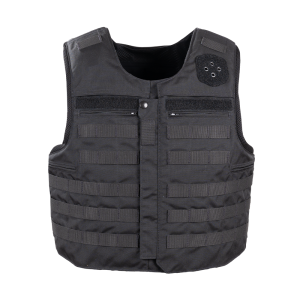
Patrol Carrier with HG2 Panels

RF1 Special Rifle Threat Plate
Why the NIJ 0101.07 Update Was Needed
The previous standard, NIJ 0101.06, had been in use since 2008. Over that time, the threat landscape facing law enforcement changed significantly — particularly with the proliferation of 5.56mm M855 Green Tip ammunition, which standard Level III plates were never tested against. Consequently, a protection gap existed between Level III and Level IV that had no formally defined or independently tested solution.
Additionally, 0101.06 testing protocols did not adequately address women’s body armor — specifically the edge vulnerability created by the shaped panels required for female-cut vests. Furthermore, the old standard bundled threat level definitions and testing methodology together, making it difficult to update one without revising the entire document.
NIJ 0101.07 addresses all three problems: it introduces RF2 to close the M855 gap, adds new angled shot testing for women’s armor, and separates threat level definitions into the companion standard NIJ 0123.00 — allowing threats to be updated independently of testing methodology in the future.
NIJ 0123.00 — The Companion Standard
NIJ 0101.07 references a new companion standard — NIJ 0123.00 — which defines ballistic protection levels and test threats separately from testing methodology. Specifically, this means the NIJ can update threat levels and test ammunition in response to new ballistic threats without having to rewrite the entire 0101.07 standard. As a result, the standards framework is now significantly more adaptable to future threats than the 0101.06 system was.
What Happens to NIJ 0101.06 Certified Armor
The most important practical question for agencies and officers is: does my current armor need to be replaced? The answer is no — at least not immediately. Armor certified under NIJ 0101.06 remains valid and on the NIJ Compliant Products List through 2027. Furthermore, agencies with 0101.06 certified armor in service are not required to replace it simply because the new standard exists.
However, NIJ stopped accepting new armor models for 0101.06 certification testing in early 2024. Consequently, new armor coming to market will increasingly be certified under 0101.07 rather than 0101.06. For agencies planning procurement cycles, understanding the new standard is now essential — particularly for grant-funded purchases where NIJ certification is a compliance requirement.
When to Expect 0101.07 Certified Products
NIJ began 0101.07 certification testing in spring 2024. As a result, a growing number of products are now appearing on the 0101.07 Compliant Products List. The transition will be gradual — manufacturers must register, test, and certify each armor model under the new standard before it can be listed. Call our specialists at 972.885.9003 for current information on which products in our catalog carry 0101.07 certification.
NIJ 0101.06 vs NIJ 0101.07:
Level Comparison
The NIJ 0101.07 body armor standards replace the old numerical level system with descriptive HG and RF designations. Use this table to understand how the levels map to each other and what threats each level is tested against under the new standard.
| Old Level (0101.06) | New Level (0101.07) | Type | Test Threats (0101.07) | Key Change |
|---|---|---|---|---|
| Level II | HG1 | Soft armor | 9mm FMJ RN 124gr @ 1,305 fps · .357 Mag JSP 158gr @ 1,430 fps | Renamed only — same core protection |
| Level IIIA | HG2 | Soft armor | 9mm FMJ RN 124gr @ 1,470 fps · .44 Mag JHP 240gr @ 1,430 fps | Faster 9mm test round — slightly more stringent than IIIA |
| Level III | RF1 | Hard plate | 7.62×51mm M80 NATO 147gr @ 2,780 fps · 5.56×45mm M193 @ 3,250 fps · 7.62×39mm MSC | Two additional rifle rounds added to test set |
| No equivalent | RF2 New | Hard plate | All RF1 threats + 5.56×45mm M855 Green Tip 62gr @ 3,115 fps | Brand new level — closes the M855 protection gap |
| Level IV | RF3 | Hard plate | .30-06 M2 AP 166gr @ 2,880 fps (single shot) | Renamed only — same core protection |
Velocities are reference velocities as specified in NIJ Standard 0123.00. Actual test protocols may vary by armor type. Consult the full NIJ 0101.07 standard for complete testing requirements.
Each NIJ 0101.07 Level
Explained in Plain Language
Here’s what each new NIJ 0101.07 body armor level means in practical terms — who needs it, what it stops, and how it maps to what you may already be wearing.
(formerly Level II)
(formerly Level IIIA)
(formerly Level III)
(no prior equivalent)
(formerly Level IV)
What Else Changed in
NIJ 0101.07 Testing
Beyond the new threat level nomenclature, NIJ 0101.07 introduces several meaningful changes to how armor is tested. Consequently, products certified under 0101.07 have passed a more rigorous evaluation than those certified under 0101.06 in several specific areas.
Women’s Armor Testing
NIJ 0101.06 did not adequately address the edge vulnerability created by female-cut soft armor panels. Specifically, shaped panels required for women’s body armor can create angled surfaces at the panel edges that were not covered by the previous flat-shot testing protocol. As a result, female officers may have been wearing armor with an untested vulnerability at the panel borders.
NIJ 0101.07 adds a 45° angled shot at the top center of soft armor panels, specifically designed to test the edge performance of both standard and women’s armor. Furthermore, for non-planar (shaped) panels, additional obliquity testing is applied. Consequently, 0101.07 certified women’s armor provides verified protection at the edges — not just at the flat center panel.
Backface Deformation Testing
Backface deformation (BFD) — the indentation created on the back of armor when it stops a round — is measured as an indicator of blunt force trauma risk. Under NIJ 0101.07, the maximum allowable BFD is limited to 44mm, with updated measurement methodology (P-BFD testing). As a result, 0101.07 certified armor is specifically required to limit not just penetration but also the blunt force injury risk from stopped rounds.
Conditioning Tests
NIJ 0101.07 introduces more realistic conditioning tests that simulate real-world wear before ballistic testing. Specifically, soft armor is subjected to tumble conditioning that simulates years of daily use — including washing, flexing, and mechanical wear. Hard armor undergoes an impact durability conditioning test based on ASTM E3078 protocols. As a result, armor must perform to NIJ standards even after simulated years of wear, not just when new out of the box.
ASTM Standard References
NIJ 0101.07 formally references American Society for Testing and Materials (ASTM) standards for specific test methods — particularly for hard armor conditioning. This integration with established ASTM protocols means armor testing now occurs within a broader, internationally recognized framework. Furthermore, accredited ballistics laboratories must demonstrate competency in ASTM-referenced procedures to test armor under the new standard.
Modular Threat Level Standard (NIJ 0123.00)
Perhaps the most structurally important change is the separation of threat level definitions into NIJ Standard 0123.00. Because threat levels are now defined in a separate document, the NIJ can update ammunition types and velocities in response to new ballistic threats without rewriting the entire 0101.07 standard. As a result, the standards framework is significantly more responsive to future threats than the previous system was.
What You Should Do About
NIJ 0101.07 Right Now
The answer depends on where you are in your armor lifecycle. Here’s specific guidance for each situation.
and your armor?
Information on this page reflects NIJ 0101.07 as published and available addenda. Standards are subject to revision — consult nij.ojp.gov for the most current version. Body armor is restricted in some jurisdictions. Federal law prohibits purchase or possession by convicted felons (18 U.S.C. § 931).